
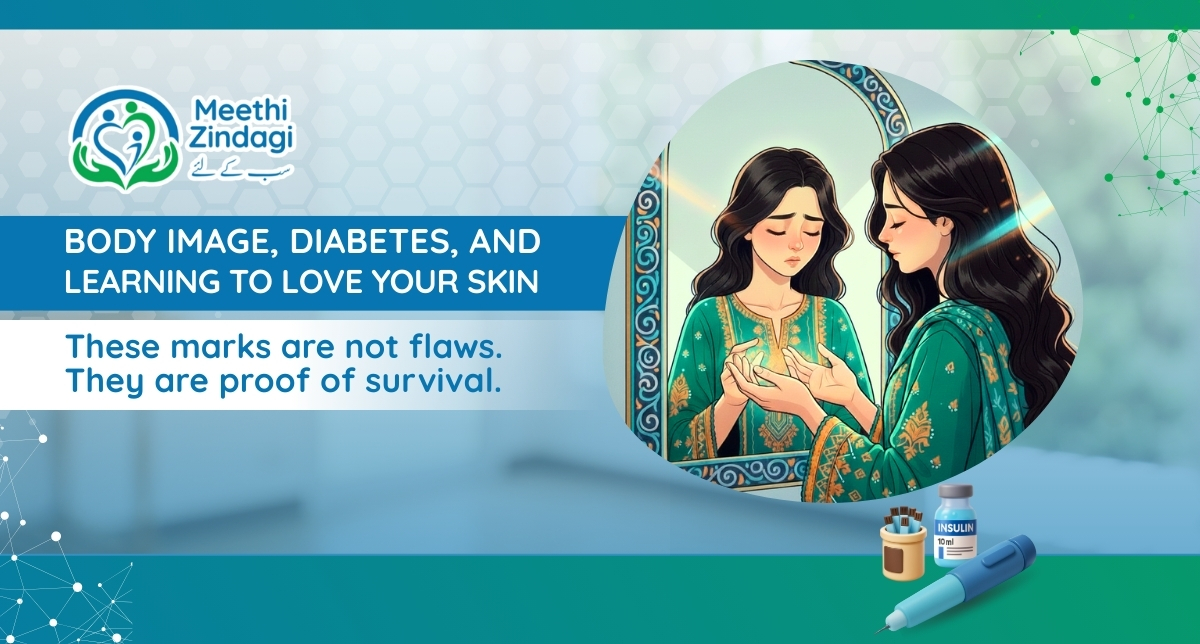
Your skin tells a story of courage, not imperfection.
Let’s be honest:
Living with type 1 diabetes doesn’t just affect your glucose levels; it affects how you see yourself. Your body becomes home to injection marks, insulin pump sites, CGM sensors, scarred patches, and sometimes weight changes you never asked for.
It’s difficult when you’re getting ready for a wedding and you’re worried the little marks on your arms will show. It’s difficult when someone casually says, “Yeh nishaan kia hai?”, not knowing how many times you’ve mentally rehearsed an explanation.
It’s difficult when you gain or lose weight because insulin isn’t a fashion accessory, it actually changes how your body behaves.
The Silent Pressure to Look Flawless
We live in a world where perfection trends every single day, where smooth skin, perfect outfits, and “flawless” pictures fill our screens from morning till night. But in all of this perfection, no one shows the CGMs, the infusion sites, or the bruises left behind by a sensor that ripped off in the middle of the night. No one posts those moments, and when you don’t see anyone who looks like you online, you slowly begin to question yourself. You start wondering if something is wrong with you, if you should hide this part of your life, if people will judge before they try to understand. And when you don’t see anyone who looks like you online, it’s easy to start questioning yourself:
“Am I the only one? Should I hide this part of my life? Will people judge me before they understand?”
Every day, countless young people manage their insulin, leaving behind small marks on their arms, stomachs, or thighs. At first, these marks might feel like something to hide like, “oh, yeh kya ho gaya?” moments. But here’s the truth: these marks are not mistakes. They’re symbols of strength, not shame. They are evidence of all the battles you’ve fought silently, the lows you survived, the doses you never skipped, the courage it takes to live fully with diabetes.
But here’s something we rarely talk about: These marks are not flaws. They’re proof of survival.
So the next time you catch your reflection, don’t look for flaws. Every mark tells a story of survival, bravery, and self-love. Every scar is a sign of resilience. These marks are your strength written on your skin, not a reason to feel shame. Own them. Celebrate them. They are as much a part of your beauty as your smile, your laugh, and your heart. Self-love isn’t about hiding or erasing the marks, it’s about embracing them as proof of everything you’ve overcome.
If any part of this feels familiar, please know you don’t have to carry it alone. There are others who understand the marks, the questions, the stares, and the silent strength it takes to live with type 1 diabetes every single day. Join our closed peer support community for people living with type 1 diabetes, where your story is understood, your experiences are respected, and your scars are seen as strength. This is a safe space to share, listen, heal, and grow together without judgment, without explanations, just support.
Link to the group:
If you’re reading this and are living with type 1 diabetes, you can join our circle of care; our Peer Support groups below:
Group for individuals with type 1 diabetes:
bit.ly/TlDsgroup
Group for parents of children with type 1 diabetes:
bit.ly/parentsofTlDsgroup
Because healing becomes easier when you’re surrounded by people who truly get it.